comment 0

When Courts Treat Fraud as “Collateral,” Children Pay the Price

Family court is supposed to serve the best interests of the child. Too often, it serves the convenience of adults instead. In my family’s case in Anoka County, Minnesota, what I believe to be medical manipulation and misuse of state programs has been treated as “collateral” in court filings by my ex-sister-in-law, Amy.

Minnesotans with disabilities or chronic illnesses who require certain levels of care may qualify for the state’s home and community-based waiver programs under the Minnesota Department of Human Services’ home and community-based service waivers.

Meanwhile, two children remain in danger because the court operates on a different timeline than the Minnesota Department of Human Services, the Office of Inspector General, and the State Attorney’s Office, allowing process and procedure to take precedence over truth.

I want to be clear about who I am. I am not the parent — I am the uncle of these two children. I love them, and I helped raise them alongside my mother from birth. Their parents are my twin brother, Marco Antonio Albino, and his now ex-wife, Amy Denice Albino.

My niece and nephew are 13-year-old twins who should be worrying about middle school, not whether the adults in their lives are telling the truth about their health. But here we are. Because when children are being harmed, silence is not an option.

For years, Amy has relied on Minnesota’s PCA (Personal Care Assistant) system. From what I observed, she exaggerated the children’s needs to qualify for services and payments. To an outsider, it might look like “extra help.” To those of us close to the situation, it often meant unnecessary treatment, questionable reports, and a cycle where financial incentives outweighed the children’s well-being.

The Early Warning Signs

Looking back, the signs were there all along. The red flags started long before the custody battles. Even before the twins were born, Amy chose to fly during her third trimester. This went against common medical guidance and raised serious concerns for the safety of both her and the unborn children.

Once the children were infants, the risks continued. Family members observed her giving them substances that appeared to sedate them, even before they were on solid food. That alarmed us deeply because we understood no doctor would condone it.

As they grew, the pattern only deepened. Medical records and family observations suggest Dennis was given migraine medication that left him sick, throwing up, and with headaches, making his condition appear worse than it truly was. Over the years, the children underwent a high volume of medical appointments and treatments that, in my view, did not align with their actual health needs and instead supported the version of events Amy presented to providers.

What should have been a safe childhood became a performance staged for paperwork and payments.

The Courtroom Impact

From my perspective, Amy used the legal system to her advantage. In court, the scope of hearings felt narrow, with opposing counsel often downplaying concerns, and agencies acknowledged issues but moved slowly to address them. In the gaps between delay and deflection, the children remained in harm’s path.

I’m not their parent, but I am family, and I’m part of their lives. When children you love are being harmed, you can’t stand by. The law may say I don’t automatically have “standing,” but I’ve asked the court to let me intervene. Now I wait to see whether the judge will allow my voice and the evidence I’ve collected into the courtroom. Because if silence is all that’s expected of me, then the system is protecting paperwork, not children.

A Larger Failure

This isn’t just my family’s story. It’s part of a larger, well-documented failure in our system. Minnesota has prosecuted major PCA and Medicaid fraud cases — including the horrific Borders case in 2025, where a mother defrauded Medicaid while physically and medically harming her children (at times drawing their blood to create false symptoms).

To me, the pattern in my family’s case looks disturbingly similar: questions of medication misuse, signs of staged illness, and children who appeared to be made sick while financial benefits flowed. If it could happen there, it can happen here.

The state has already acknowledged that these systems are vulnerable to abuse, yet when the same warning signs appear in family court, they’re often treated as distractions. Agencies investigate on one track while custody proceedings move ahead on another, splitting the truth and leaving children unprotected.

Why I’m Writing

I’m writing this because I believe sunlight matters. Silence allows people to continue harming others. And I refuse to let my niece and nephews’ voices be drowned out by legal maneuvers and professional excuses.

Family court claims to serve the best interests of the child. If that principle means anything, it must include listening when children are being put in harm’s way — no matter who brings the evidence forward.

If you’ve read this far, please share this story. Shine a light on how the system works …and how it fails. The more people understand, the harder it becomes for courts and agencies to ignore the truth.

Awareness is protection. And these kids need all the protection they can get.

A Broader Warning

This isn’t only about my niece and nephew. It’s a warning to other families across Minnesota: if the court can overlook fraud and manipulation here, it can ignore it anywhere. What happened in the Borders case shows how quickly abuse can hide inside “the system,” and my family’s case shows how easily the process can leave those raising alarms feeling unheard.

I plan to follow up and share more case details as proceedings move forward, because accountability depends on memory and record. The children deserve to have their truth remembered, not buried.

Disclaimer:

The information in this post reflects my personal experiences, observations, and opinions. References to court proceedings, medical concerns, and agency actions are based on publicly available records and my understanding of events. Nothing here should be taken as a legal conclusion or medical diagnosis. Readers are encouraged to review official documents and news sources for verification.

Awareness is protection — and these kids need it.

comment 0

Why I Am Publishing a Formal Federal Referral Regarding Child Safety in Minnesota Family Court

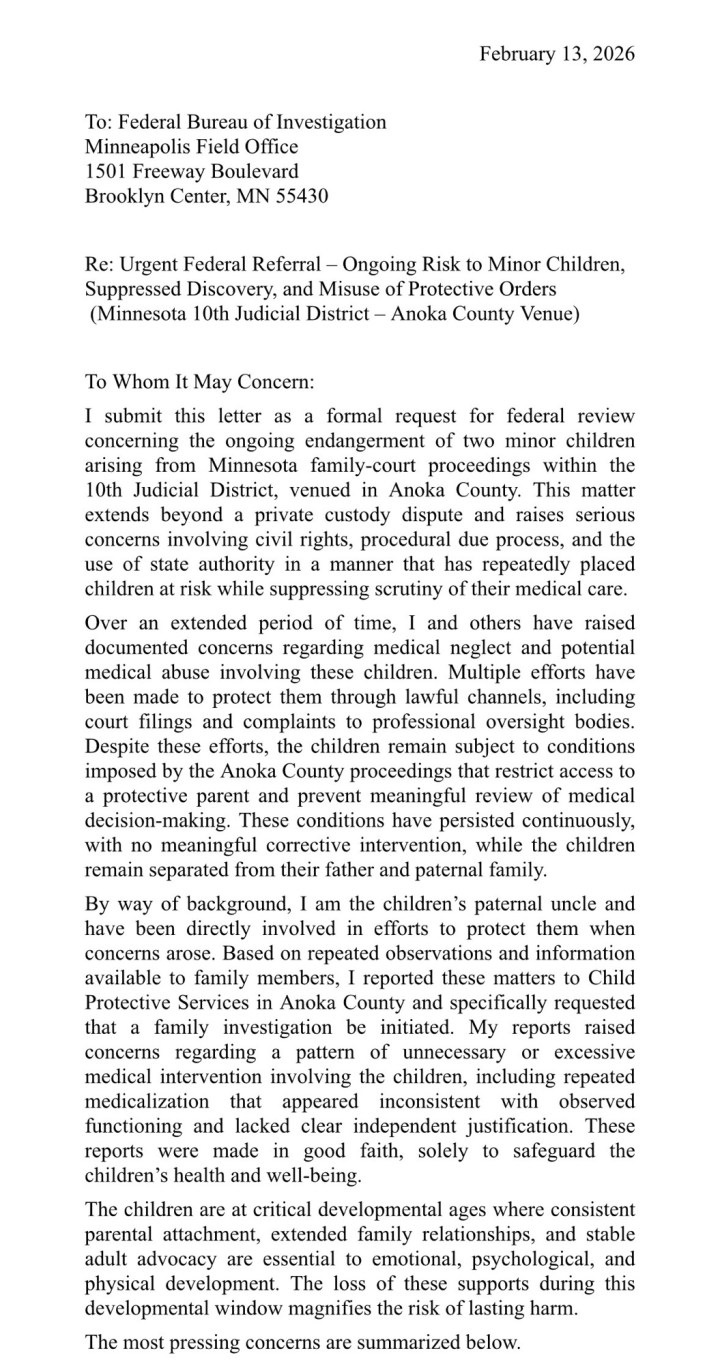
The following letter is published verbatim to preserve accuracy and transparency. Minor identifying information has been omitted or redacted to protect the privacy of children.

This referral arises in connection with family court proceedings in Minnesota’s Tenth Judicial District, Anoka County District Court, Court File Nos. 02-FA-23-1889 and 02-FA-23-1608. The matters referenced were presided over, at various times, by Judge Carrie A. Doom, appointed in September 2025 by Governor Tim Walz, and Judge Kevin J. Mueller, appointed in 2022 by Governor Tim Walz. This letter is shared publicly to preserve accuracy, transparency, and record integrity.

February 13, 2026

To: Federal Bureau of Investigation
Minneapolis Field Office
1501 Freeway Boulevard
Brooklyn Center, MN 55430

Re: Urgent Federal Referral – Ongoing Risk to Minor Children, Suppressed Discovery, and Misuse of Protective Orders    (Minnesota 10th Judicial District – Anoka County Venue)


To Whom It May Concern:

I submit this letter as a formal request for federal review concerning the ongoing endangerment of two minor children arising from Minnesota family-court proceedings within the 10th Judicial District, venued in Anoka County. This matter extends beyond a private custody dispute and raises serious concerns involving civil rights, procedural due process, and the use of state authority in a manner that has repeatedly placed children at risk while suppressing scrutiny of their medical care.

Over an extended period of time, I and others have raised documented concerns regarding medical neglect and potential medical abuse involving these children. Multiple efforts have been made to protect them through lawful channels, including court filings and complaints to professional oversight bodies. Despite these efforts, the children remain subject to conditions imposed by the Anoka County proceedings that restrict access to a protective parent and prevent meaningful review of medical decision-making. These conditions have persisted continuously, with no meaningful corrective intervention, while the children remain separated from their father and paternal family.

By way of background, I am the children’s paternal uncle and have been directly involved in efforts to protect them when concerns arose. Based on repeated observations and information available to family members, I reported these matters to Child Protective Services in Anoka County and specifically requested that a family investigation be initiated. My reports raised concerns regarding a pattern of unnecessary or excessive medical intervention involving the children, including repeated medicalization that appeared inconsistent with observed functioning and lacked clear independent justification. These reports were made in good faith, solely to safeguard the children’s health and well-being.

The children are at critical developmental ages where consistent parental attachment, extended family relationships, and stable adult advocacy are essential to emotional, psychological, and physical development. The loss of these supports during this developmental window magnifies the risk of lasting harm.

The most pressing concerns are summarized below.

First, the court has twice extended an Order for Protection issued within the 10th Judicial District that severely limits the children’s relationship with their father. These extensions have been issued without resolving fundamental evidentiary deficiencies and without findings sufficient to justify prolonged separation. The practical effect has been the sustained removal of a protective and involved parent from the children’s daily lives, contrary to well-established child-welfare principles and without adequate procedural safeguards.

The Order for Protection further compounds these risks by including language that restricts discussion of prior abuse and safety concerns, while simultaneously granting the Petitioner unilateral decision-making authority over matters affecting the children. This structure effectively silences the non-custodial parent and removes a critical layer of protection. It limits the father’s ability to question medical decisions, raise concerns with providers or authorities, or advocate for the children’s safety without fear of violating the order. In practice, this has operated as a barrier to reporting and oversight rather than a protective measure.

Although the Order for Protection formally applies to the children’s father, its restrictions on his speech, contact, and decision-making have significantly limited his ability to raise or pursue safety concerns. Because he is the primary protective parent and medical advocate, these limitations have had the practical effect of reducing external scrutiny at a time when independent review is most needed. The structure and enforcement of the Order for Protection has also created a chilling effect on the reporting of safety concerns.

Second, unresolved discovery failures continue to obstruct independent review of matters directly affecting the children’s safety. Required discovery was not fully produced during the period when the Petitioner was represented by counsel who has since been appointed to the bench. Those deficiencies were never cured. Missing discovery includes medical records, provider communications, and billing information. At no point has a neutral, independent fact-finding process been allowed to evaluate medical necessity or competing safety concerns.

Third, the court has permitted ongoing parental and familial alienation within the Anoka County venue. The children have been isolated not only from their father but also from the paternal side of their family, depriving them of extended family support and additional protective adults. Despite awareness of this harm and authority to intervene, the court has not implemented corrective measures or less-restrictive alternatives, such as public or structured parent-child contact, that would preserve safety while fostering familial bonds.

Taken together, these actions reflect a consistent pattern within proceedings of the 10th Judicial District: protective orders are repeatedly extended, discovery remains unresolved, speech regarding safety concerns is restricted, unilateral decision-making is imposed, neutral fact-finding is prevented, and meaningful parental and familial involvement is curtailed while allegations of medical neglect remain unexamined. The consistency of these outcomes suggests systemic failure rather than isolated error. Continued delay risks irreversible harm to the children’s development and familial bonds.

I am not seeking federal involvement to resolve custody disputes. I respectfully request review to ensure that child safety, civil-rights protections, and lawful oversight mechanisms are not being undermined by the misuse or misapplication of state authority.

I am fully willing to cooperate with any inquiry, provide sworn statements if requested, and supply documentation upon request.

Respectfully,

Rick Sage